

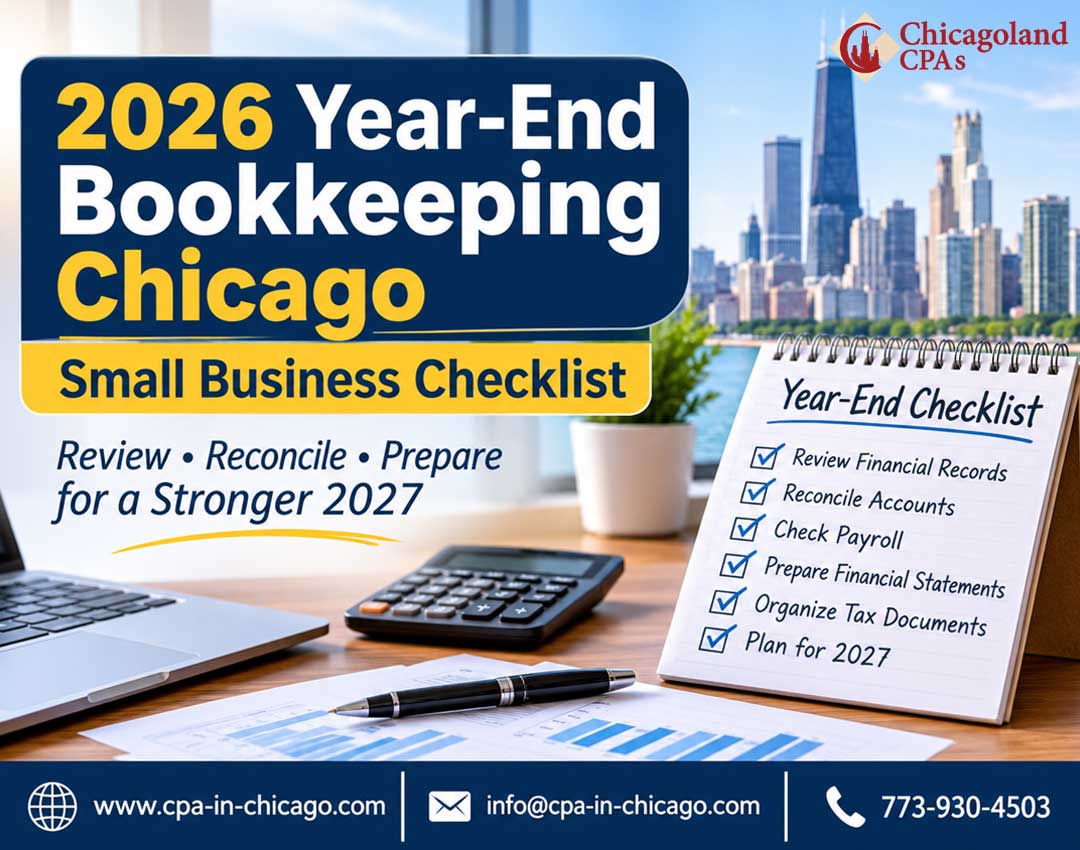
It’s very crucial to do year-end bookkeeping Chicago. Thus, you can make your small business kick off the new financial year in the best possible way. At the end of 2026, your accounts should be up-to-date. Completing this at the correct time will remove incorrect accounting entries.
Here at Chicagoland CPAs, we know how important it is to keep your financial records accurate. Do you belong to the construction, restaurant, retail or professional services industry? In any case, completing a year-end bookkeeping checklist will help you get financially ready for 2027 & beyond.
1. Review Your Small Business Financial Records
You should start by checking the accuracy of all business transactions in 2026. Be alert to missing entries & duplicate transactions. Incorrectly categorized expenses will ruin the financial reports.
See for these papers:
- Sales invoices & client payments
- Company’s purchase receipts
- Vendor invoices
- Bank and credit card statements
- Loans & interest docs
- Payrolls & worker-related expenditures
With precise small business financial records, owners can identify missing transactions. Plus, they will be able to verify reported income & expenses.
Are you getting incomplete entries? Then, correct them before doing the financial close.
2. Complete Year-End Account Reconciliation
Reconciling your financial accounts can’t be abandoned in year-end bookkeeping. Compare your accounting records with bank & credit card statements. This way, you can confirm that the recorded balances match real transactions.
Notice:
- Missing withdrawals, deposits
- Fake payments
- Unrecorded bank charges
- Remaining checks
- Wrong transaction amounts
- Unknown buying
Review every business bank account & credit card distinctly. Each account needs to be reconciled with respect to the suitable closing date.
This process identifies discrepancies early. Plus, this gives business owners confidence in their financial journey.
3. Review Business Income, Expenses, and Outstanding Payments
With a review of income & overheads, you can know how your business performed. Confirm that all revenue has been recorded. Make sure that expenses are showing under the right groups.
You should see accounts receivable & accounts payable.
- Accounts receivable: Identify customers with unpaid invoices and follow up on overdue balances.
- Accounts payable: Find out remaining supplier invoices & recurring bills. Watch out for other business obligations. Thus, you can confirm that liabilities are recorded.
Reviewing these figures helps identify delayed customer payments & rising operating costs. Businesses seeking support with transaction recording & account reviews should go for professional accounting and bookkeeping services.
4. Check Payroll and Employee Records
Firms should be watchful about payroll before closing books for 2026. They must maintain employee wages & contractor payments. Plus, they should keep an eye on payroll taxes & benefit expenses.
The payroll assessment needs to have:
- Worker info & compensation records
- Payment validations
- Payroll tax charges
- Contractor payment paperwork
- Worker benefits & costs
See if federal & Illinois payroll reporting necessities are obeyed. With precise payroll records, firms can stop reporting discrepancies. This guarantees unfailing financial reporting.
5. Review Inventory, Equipment, and Business Assets
Does your business sell products or own equipment? You should check your inventory & fixed asset records. Then, you can go on to finalize the books.
Do you work with a lot of inventory? Then, compare physical stock with the quantities recorded in your accounting system. See the damaged products, returns, theft & recording errors.
For equipment & other business assets, check-
- Equipment purchased during 2026
- Assets sold or disposed of
- Repair and maintenance costs
- Depreciation papers
- Equipment loans & outstanding balances
Retailers, restaurants & construction companies must assess equipment records. Such things affect financial reporting in a great way.
6. Complete Financial Statement Preparation
Firstly, firms need to review transactions & reconcile accounts. Then, they should get ready for year-end financial statements. Financial statement preparation helps business owners a lot. They can understand profitability & available resources. Plus, they can handle outstanding monetary obligations.
The 3 main financial statements are:
- Profit and Loss Statement: This displays company revenue & net profit. Plus, this displays loss within a period.
- Balance Sheet: This summarizes business assets & liabilities. It also contains owner’s equity.
- Cash Flow Statement: Details about operating, investing & financing activities.
Review these reports to identify in any kind of changes. Comparing your 2026 results with the last period is important. Thus, you can monitor financial trends. You will surely figure out the domains demanding attention.
7. Organize Documents for the Upcoming Tax Season
Then, organize the documents. These help with business tax setup. Having everything ready reduces last-minute requests. Plus, this makes communication with your tax preparer simpler.
Gather documents like:
- Per year’s income & expenses
- Bank, credit card papers
- Payroll payments
- Debts & interests
- Equipment purchase & depreciation archives
- Inventory reports
- Business tax payment records
You need to keep these documents in clearly labelled digital/physical folders. Your accountant can then review these. They will find out any extra data required as per federal, Illinois & local tax laws.
8. Plan Your 2027 Finances With Better Bookkeeping
Closing your books should also help you get ready for the next year. You will have to review your revenue & operating costs. Be careful about cash flow & outstanding debts. Check profitability too!
For 2-27, consider setting a budget & reviewing pricing. Plus, you need to plan major purchases & set truthful economic goals.
Does maintaining accurate records feel difficult? Well, expert bookkeeping services for businesses offer support with transaction recording. You can also opt for reconciliations & financial reporting. By partnering with experienced bookkeeping firms, owners can maintain better accounting processes 365 days a year.
Are you in need of ongoing assistance? Then, you should think about small business bookkeeping services once. These make financial recordkeeping more manageable. So, owners will be left with more time. And they can peacefully concentrate on regular operations.
Why Year-End Bookkeeping Chicago Businesses Should Prioritize Matters
Completing your year-end bookkeeping Chicago tasks isn’t just an administrative duty. This way, you can understand business performance & identify accounting issues. Plus, you can organize tax documents & make better monetary choices.
With consistent bookkeeping, companies can see financial reports 365 days a year. They don’t need to wait for December. Business owners should consider professional bookkeeping support for 2027 & beyond.
How Chicagoland CPAs Can Help With Year-End Bookkeeping
Are you a small business owner? Chicagoland CPAs know that setting up for a year-end financial close can be tough. We handle your firm’s daily operations. We also deal with accounting, bookkeeping & tax preparation support. With us, Chicago organizations can have their financial records in order.
Our services comprise:
- Recording & categorizing transactions
- Bank & credit card reconciliation
- Tracking income and business expenses
- Preserving precise payroll records
- Making economic statements
- Handling tax preparation
We offer professional bookkeeping support. With us, you can maintain more consistent financial records. You’ll make optimal decisions for the next calendar year.
Final Thoughts
A proper financial close helps Chicago small businesses a lot. They can finish 2026 with organized records. Plus, they’ll get a clearer view of their financial state. They should assess transactions & reconcile accounts. They must check payroll & inventory. Also, they will have to get ready with financial statements for tax season.
Following these steps can make year-end bookkeeping Chicago more manageable. Chicagoland CPAs support small businesses a lot. They can opt for professional bookkeeping, accounting & tax preparation services.
Contact Us to learn how Chicagoland CPAs can help your company scale.
Our Contact Details:
info@cpa-in-chicago.com
773-930-4503
5519 N Cumberland Ave, Suite 1003 Chicago Illinois 60656
FAQs
Q. What should a small business include in its year-end bookkeeping checklist?
Ans: A year-end bookkeeping checklist must have transaction reviews & bank reconciliation. There must be payroll verification & inventory checks. There has to be financial statement preparation & tax document organization.
Q. Why is year-end bookkeeping important for small businesses?
Ans: Year-end bookkeeping identifies accounting errors & reviews business performance. Plus, this organizes tax records & generates accurate financial reports.
Q. What are the steps to prepare financial statements?
Ans: Companies need to review transactions, verify assets & liabilities. They must categorize income & expenses. Then, they shall prepare a profit and loss statement, balance sheet & cash flow records.
Q. What is financial statement preparation?
Ans: Financial statement preparation means organizing accounting records. These become reports showing a firm’s profitability & cash flow.
Q. When should a small business close its books for the year?
Ans: A small company should complete its year-end financial close after 31st December. Firstly, all the transactions for 2026 need to be recorded & reviewed.
Q. Should small businesses hire a professional for year-end bookkeeping?
Ans: Yes. Professional bookkeeping support from Chicagoland CPAs helps firms a lot. They can reconcile accounts & organize financial records. We also help them to prepare reports. With us, they can gear up for tax season.